
Brampton
Dentists That Accept CDCP in Brampton
You finally get approved for the **Canadian Dental Care Plan (CDCP)**… then you show up for your appointment and hear words nobody wants to hear:
- Home
Date
- 03.03.26
You finally get approved for the Canadian Dental Care Plan (CDCP)… then you show up for your appointment and hear words nobody wants to hear:
“ That part isn’t covered.”
“ You’ll have a co-pay.”
“ There may be an extra amount owing.”
This guide is here to prevent that moment.
If you’re searching “dentists that accept CDCP”, the goal isn’t just to find any clinic.
It’s to find a clinic that (1) participates, (2) can bill CDCP properly, and (3) helps you understand coverage before you sit in the chair.
The Government of Canada outlines what the plan covers and how to use it, while Sun Life provides tools to find participating providers.
What “Dentists That Accept CDCP” Actually Means
A clinic “accepting CDCP” usually means:
- The provider is willing/able to treat CDCP clients
- The provider agrees to bill and receive payment through the CDCP process (Sun Life is the plan administrator)
- The clinic can confirm coverage for your planned treatment and explain any out-of-pocket costs (co-pay and/or differences in fees)
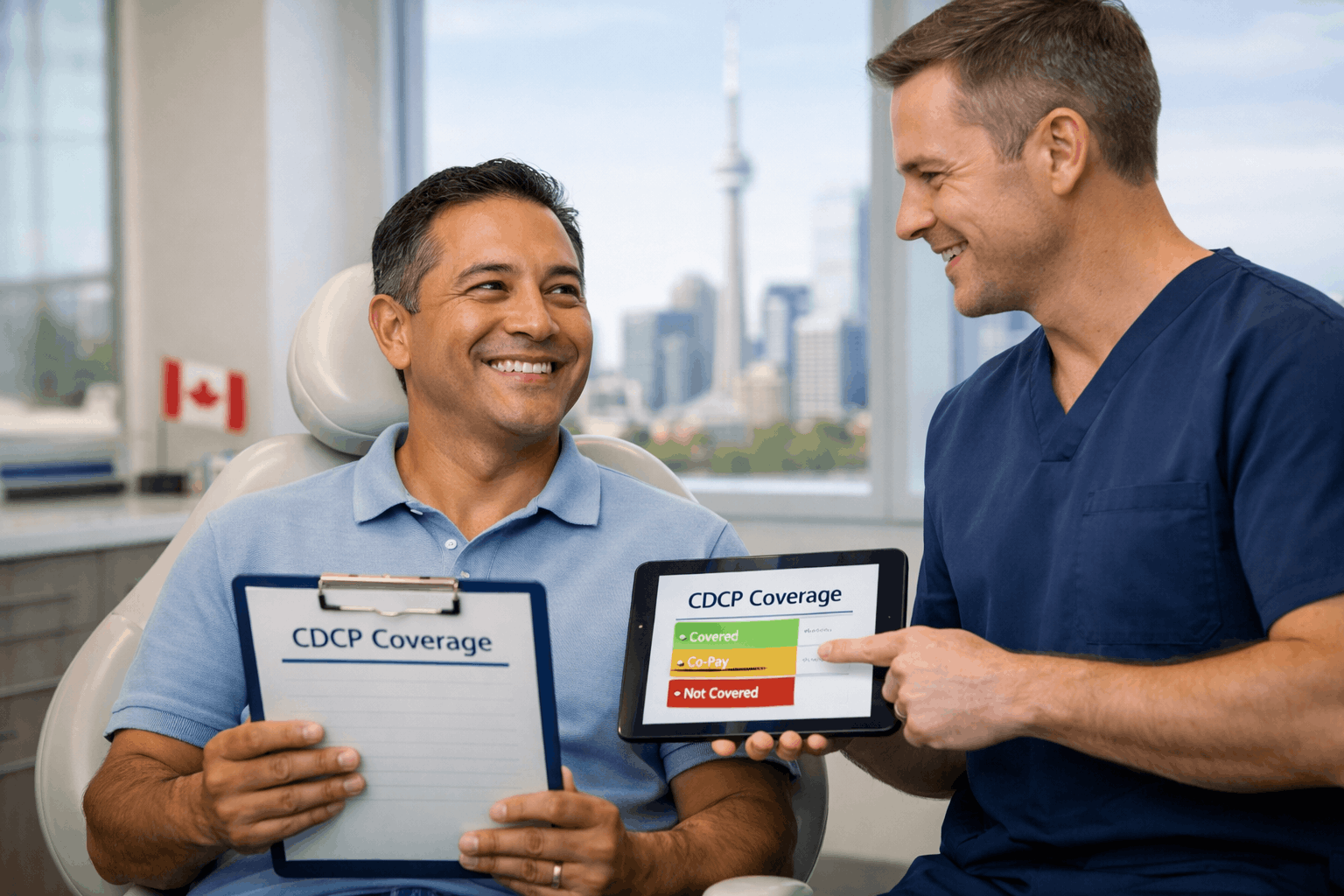
Important reality: participation can vary by clinic/provider and can change over time, so it’s smart to confirm before you book.
How to Find Dentists That Accept CDCP (Fast)
Option A: Use the official CDCP provider search
Sun Life hosts a CDCP Provider Search Tool to help you find providers near you.
Option B: Call clinics directly (and ask the right question)
Not every clinic you see online will be in the directory or updated yet. Sun Life also suggests contacting providers directly and asking if they can accept CDCP clients and bill/receive payment.
Option C: Call Sun Life CDCP Contact Centre
If you’re stuck, you can call Sun Life’s CDCP Contact Centre for help finding a provider.
What CDCP Covers: The Big Categories (Plain English)
CDCP is designed to help with essential oral health care—think prevention, diagnosis, treating decay/infection, gum care, extractions, dentures, and more.
The Government of Canada provides a detailed breakdown of covered services and benefit rules.
Here are the main buckets people typically use:
1) Exams and diagnostic care
This includes things like checkups/exams and X-rays (coverage depends on plan rules and frequency limits).
2) Preventive care
This is your “keep problems small” category—cleanings and preventive services, subject to the plan’s policies and frequency rules.
3) Restorative care (fixing cavities/broken teeth)
The federal coverage page explicitly lists examples like permanent fillings, temporary fillings, and pain control for diseased teeth, plus other cavity-related treatments.
4) Endodontic care ( root canal-type services)
The Government’s coverage materials include endodontic services as part of covered categories (with plan rules that may apply).
5) Periodontal care (gum disease care)
If you have gum issues, CDCP includes periodontal-related services within its covered framework (again, based on plan policies and limitations).
6) Oral surgery (like extractions)
Extractions and certain oral surgery services can be covered depending on the CDCP coverage rules and preauthorization needs.
7) Dentures and other prosthodontic services
Some removable prosthodontic services (like dentures) may be covered according to CDCP rules and limitations.
What CDCP Typically Does NOT Cover (The “Surprise” Zone)
This is where most confusion happens.
The Government of Canada’s Dental Benefits Guide makes it clear that not all oral health care services are covered and that certain requests can be reviewed and declined via preauthorization.
Common “not covered / not usually covered” areas include:
Cosmetic dentistry
If the main goal is aesthetic (not medical necessity), it’s often not covered. That usually includes:
- Teeth whitening
- Veneers
- Other purely cosmetic smile upgrades
(Always confirm—coverage depends on CDCP rules, and clinics can verify for your specific treatment plan.)
Anything outside plan rules or approved preauthorization
If a procedure requires preauthorization and it’s declined, CDCP won’t pay for it.
The 2 Reasons You Might Still Pay Something (Even at a CDCP Dentist)
1) Co-pay (co-payment)

Sun Life defines co-pay as the percentage of CDCP fees not covered that you pay directly to the provider.
2) Differences between clinic fees and CDCP established fees
Even people with no co-payment may face additional charges if the provider charges more than CDCP established fees (often called balance billing in everyday conversation). Sun Life notes this possibility in its provider FAQ context.
Bottom line: “CDCP accepted” doesn’t automatically mean “$0 visit.”
Preauthorization: When CDCP Wants a “Yes” Before Treatment
Some services may require preauthorization—meaning the clinic submits details first, and CDCP decides if it will be covered.
The Dental Benefits Guide notes coverage beyond frequency limits can be requested through preauthorization, and also emphasizes that services can be declined through this review process.
Smart move: if your treatment plan is complex (major restorative work, dentures, surgical care), ask the clinic:
- “Will any part of this require preauthorization?”
- “Can you confirm coverage before we begin?”
A Simple “No Surprise” Checklist Before You Book
When you call a clinic from your “dentists that accept CDCP” search, ask these 6 questions:
- Are you currently accepting CDCP patients?
- Can you bill Sun Life directly for CDCP services?
- Can you confirm my coverage before treatment starts?
- Will I have a co-pay? (depends on your CDCP status/income bracket)
- Could there be any extra charges beyond CDCP established fees?
- Do any recommended services require preauthorization?
If the clinic answers clearly, you’re in good hands.
1) How do I find dentists that accept CDCP in Brampton?
Use Sun Life’s CDCP Provider Search Tool, or call clinics directly to ask if they accept CDCP clients and can bill/receive payment through Sun Life.
2) If a dentist accepts CDCP, will my visit be free?
Not always. You may have a co-pay, and you may also owe extra if the clinic’s fees are higher than CDCP established fees.
3) What services are covered under CDCP?
CDCP covers a range of essential services. For example, the Government’s coverage page lists restorative examples like permanent fillings, temporary fillings, and pain control for diseased teeth, with additional categories outlined in the CDCP materials.
4) Does CDCP cover teeth whitening or cosmetic dentistry?
CDCP is focused on essential oral health care, and not all services are covered per the Dental Benefits Guide—cosmetic procedures are commonly outside coverage. Always confirm for your specific case.
5) What is preauthorization in CDCP?
Preauthorization is when a provider requests approval before delivering certain services. The Dental Benefits Guide notes CDCP can review requests (including those beyond frequency limits) and can decline coverage through preauthorization.
6) What should I ask a clinic before booking under CDCP?
Ask if they accept CDCP patients, if they can bill Sun Life directly, whether you’ll have a co-pay, whether extra charges may apply above CDCP established fees, and whether any services need preauthorization.
PrevPrevious
NextNext
More articles
Root Canal Treatment Side Effects: Things You Must Know Beforehand
July 13, 2026
Tooth Filling Price in Brampton: What Affects the Cost of Treating a Cavity?
July 8, 2026
Emergency Walk-In Dentist in Brampton: What to Do When Dental Pain Can’t Wait
June 19, 2026
Ready to smile?
Book with a Brampton dentist you can trust
Free consultations · Direct insurance billing · Same-day emergencies